Offer · Materials
Blown-in insulation that fills every gap.
Wood fibre or cellulose blown by machine into floors, roofs and walls: no cutting, no waste, no bridges at the joints. The material goes where it should and stays there. As an official STEICO distributor we sell STEICOzell, STEICOtimberfloc and STEICOfloc and blow them with our own equipment, in our houses and in other people’s.
Official STEICO distributor
How it works
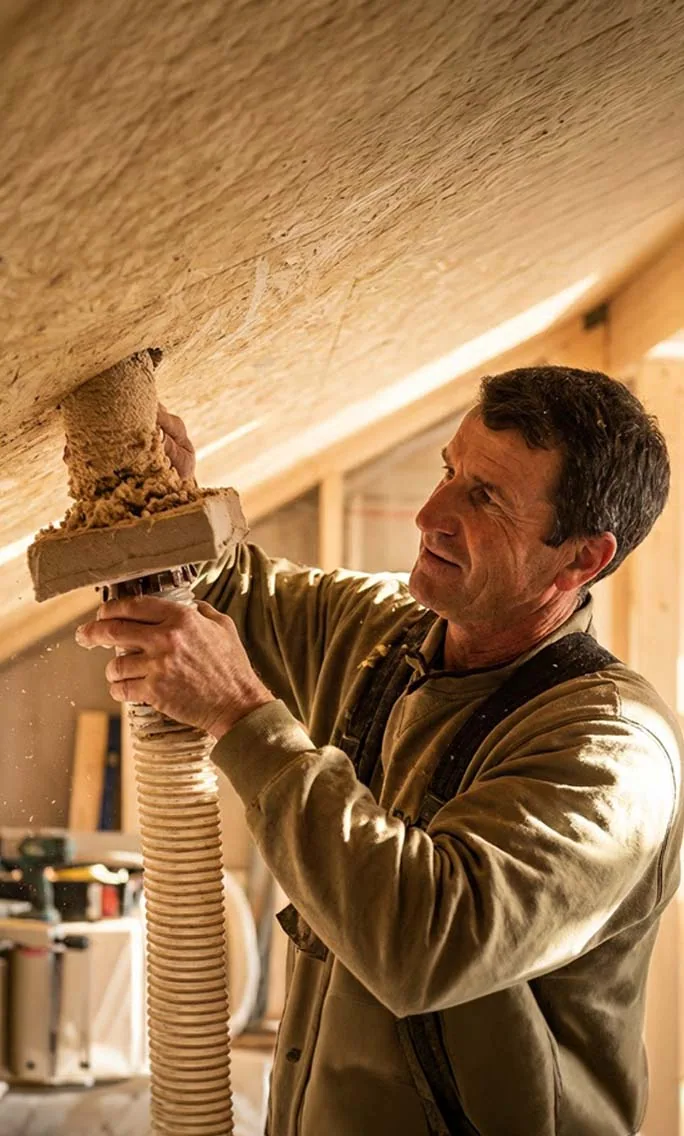
A hose instead of a knife
Four steps from the bale to a finished element.
- 01
A closed cavity
Between rafters, studs or joists there is a space closed with a board or a membrane. All it needs is a hole for the hose.
- 02
The machine and the hose
The machine loosens the compressed fibre and pushes it through the hose under pressure. The fibres reach every corner, behind the services and around the boxes.
- 03
Density under control
We dose as many kilograms per cubic metre as the place needs: looser on an open attic floor, denser in a wall, so nothing settles. We check by weighing and probing.
- 04
Done the same day
The hole is closed and the element is complete. The attic floor of a typical house takes a day, with no cutting and no bags of waste.
Calculator
How much insulation do you need?
Choose what you are insulating, the product, the area and the thickness. The drawing shows the layer; the numbers give the U-value against WT 2021, the kilograms of material and the heat that still gets out. A joisted floor, a roof and a wall are filled densely in a closed cavity; under roof trusses the fibre is blown loose and with an allowance, because such a layer settles with time.
A floor on STEICOjoist or solid timber joists: a closed cavity, filled densely, like a wall or a roof.
- U-value0.13 W/m²KWT 2021 asks for ≤ 0.15: 10 % better
- Material1 440 kg96 bags of 15 kg
- Lost a year1 393 kWhthrough this element; on the WT 2021 limit (U 0.15) it would be 1 555 kWh
- Thickness for the norm27 cmenough for WT 2021 (U ≤ 0.15)
Losses are worked out for the climate of Rzeszów, about 3 600 degree-days. A guide, not an audit. Count the heating costs of the whole house
Quote
Send these figures for a quote
We reply with the price of the material and the blowing. For an old attic, say whether there is a floor on joists and how one gets up there.
Blown-in insulation quote from asasak.pl: joisted attic floor, 120 m², STEICOzell 30 cm, about 1 440 kg of material, U 0.13 W/m²K.
Where do these numbers come from?
- U-value
- U = 1 / (R_si 0.10 + fixed layers 0.25 + d / λ + R_se 0.10), λ = 0.038 W/mK. In a roof, a wall and a joisted floor 6 % of the area is timber (λ 0.13), counted as a separate path.
- Material
- 40 kg/m³ × 120 m² × 30 cm = 1 440 kg. The installed density depends on the place: loose under the trusses, denser in a closed cavity so that nothing settles.
- The heat that gets out
- U 0.13 × 120 m² × 86 400 degree-hours (about 3 600 degree-days for Rzeszów) = 1 393 kWh a year; an element right on the WT 2021 limit (U 0.15) would lose 1 555 kWh.
Guide figures to EN ISO 6946 for the insulation layer alone; a real element has other layers and bridges. Lambda values as declared by STEICO.
Three products
Wood fibre, cellulose or a blend
All three are blown with the same machine. They differ in raw material, density and what the element needs.
| Raw material | λ | Installed density | Reaction to fire | Heat capacity | Where |
|---|---|---|---|---|---|
| STEICOzellWood fibre from softwood | 0.038 W/mK | 32 to 45 kg/m³ | E | about 2 000 J/(kg·K) | Walls, roofs and floors of timber frame houses: our standard |
| STEICOtimberflocWood fibre with cellulose | 0.039 W/mK | 30 to 45 kg/m³ | E | about 2 000 J/(kg·K) | Floors and roofs where price matters at the same performance |
| STEICOflocCellulose from recycled paper | 0.038 W/mK | 30 to 55 kg/m³ | E | about 2 000 J/(kg·K) | Floors, lofts and walls in renovations, masonry too |
Values as declared by the manufacturer. The fire class is for the material itself; in an element the boards protect it and the classification is made for the whole wall.
Why blown-in
Five things a board or a batt cannot do
- 01
No gaps
Cut wool leaves gaps at studs and services; blown fibre fills them all. A gap at a stud is a bridge you do not see on the invoice but do see on the bill.
- 02
No settling
Wood fibres wedge against each other. Blown in at the right density they stay put for decades, as the European technical assessment confirms.
- 03
Cool in summer
Wood fibre stores about twice as much heat as mineral wool. A roof with 24 cm of STEICOzell lets a temperature swing 23 times weaker into the attic than outside.
- 04
It breathes
The element stays diffusion-open: water vapour passes through the fibre and dries out instead of condensing on a foil.
- 05
Quiet
Densely packed fibres damp sound better than light batts. You hear it in a floor between storeys and in a roof when it rains.
Watch
This is what blowing looks like
Two short films from site.
Questions
What people ask before their first blowing
- Does blown-in insulation settle?
- In a closed element we blow it in at a density where the fibres wedge against each other and have nowhere to settle; the manufacturer holds an assessment for it. On an open attic floor we add a margin of thickness, because a loose layer beds down a little in the first weeks.
- Can an attic be insulated without lifting the floor?
- If the floor lies on joists, holes are enough: we fill the space under the boards and close them. If there is no floor, we blow loosely on top to the marked thickness.
- How long does it take?
- The attic floor of a typical house, 100 to 150 m², takes a day including the drive. Walls and roof of a timber frame house are blown during prefabrication or on site, usually in two days.
- What about moisture and mice?
- Wood fibre takes up and gives off water vapour, so in a diffusion-open element there is nowhere for it to condense. The material is no food for rodents, and STEICOfloc cellulose is additionally protected with mineral salts.
- Is it flammable?
- All three, STEICOzell, STEICOtimberfloc and STEICOfloc, are reaction-to-fire class E, like most wood products. In an element the fibre is closed in by boards that let no air in, and fire resistance is rated for the whole wall or floor.
- How much does blown insulation cost?
- In our shop STEICOzell costs from 2.60 zł per m² for every centimetre of blown layer on a ceiling, 3.50 zł in sloping roofs and 3.90 zł in walls. A ceiling with a 30 cm layer comes to about 78 zł per m². An advisor gives the exact price, travel included, from the dimensions in the calculator.
Where
Loft, roof, walls
Floor under an unheated loft
The fastest return on every złoty: 30 to 40 cm blown loosely on top, without lifting a floor that lies on joists.
Roof between rafters
A full fill of 20 to 30 cm with no gaps at the rafters. In our roofs with a STEICOuniversal board instead of a membrane.
Walls of a timber frame house
Closed bays between the studs filled at 45 kg/m³. This is how all our wall build-ups are made.
Let's talk
Your attic could be next.
Design, structure and materials from one company. Call or write. An advisor will tell you where to start.